
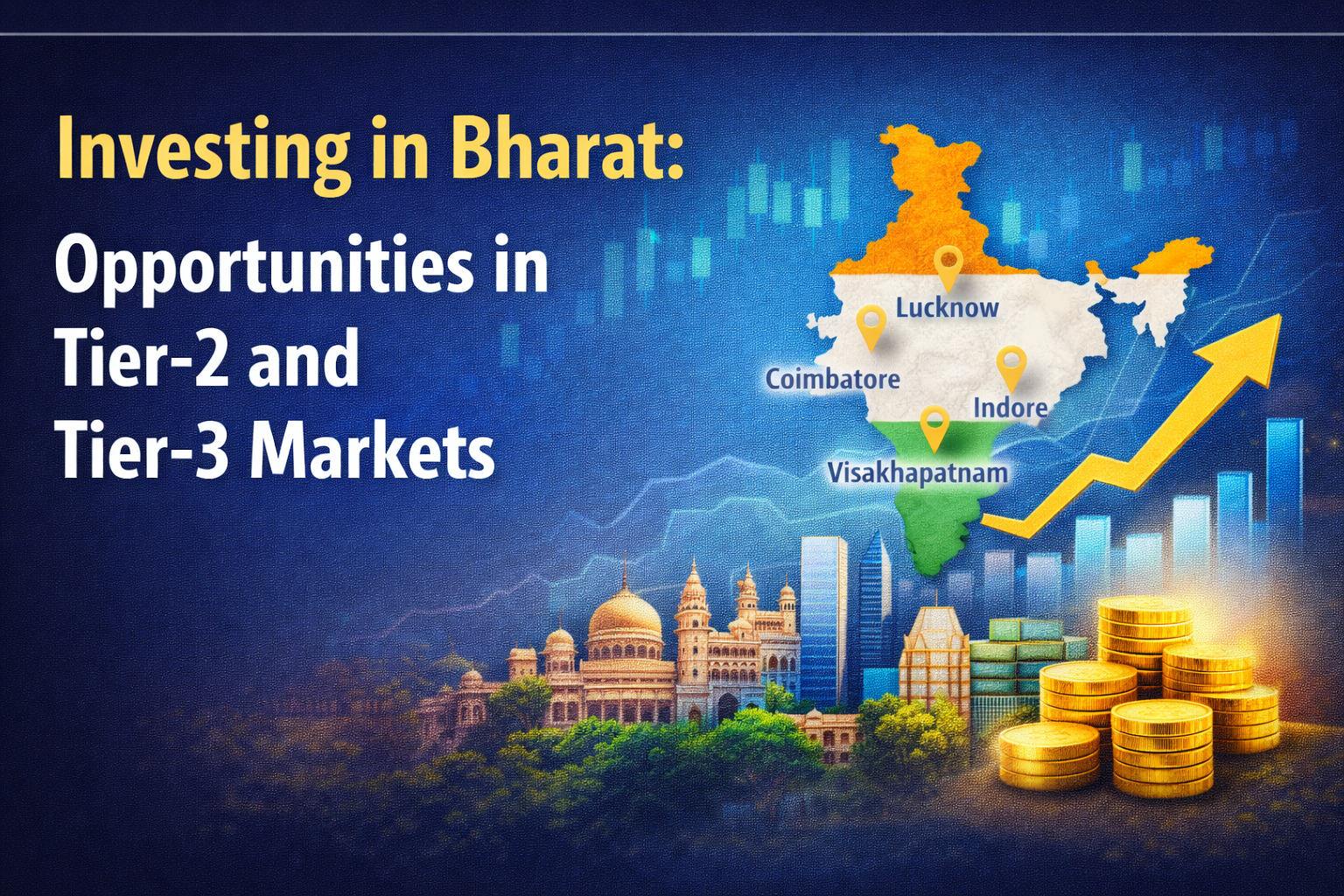
Investing in Bharat: Opportunities in Tier‑2 and Tier‑3 Markets
Explore investment opportunities in India's Tier‑2 & Tier‑3 cities, rising consumption, digital adoption, and their impact on the Indian stock market today.
For decades, India's growth narrative was dominated by its metros—Mumbai, Delhi, Bengaluru. But the story of Bharat, the rapidly transforming Tier-2 and Tier-3 cities, is now redefining the country's economic future. These emerging urban hubs are no longer just "small towns"; they are high-potential investment centers powered by infrastructure upgrades, digital penetration, rising incomes, and a booming entrepreneurial ecosystem. Multiple recent reports and expert insights confirm that India's next phase of growth will be driven not by metros, but by the aspirations and purchasing power of these smaller cities.
Why Bharat Is Becoming the New Investment Frontier
1. Infrastructure That Accelerates Investment
Government investment in logistics, airports, highways, and smart city initiatives has dramatically improved connectivity in urban clusters like Coimbatore, Lucknow, Thiruvananthapuram, Visakhapatnam, and Jaipur. These cities are witnessing significant projects:
- Coimbatore recorded 14.42% growth in property registration revenues and is developing a 714‑acre township (₹707 crore). It is also emerging as an AI and tech startup hub.
- Thiruvananthapuram is developing new Technoparks, data center parks, and industrial estates.
- Visakhapatnam has attracted large‑scale investments, including Google and AdaniConneX's massive $15 billion AI data center campus.
Improved connectivity
Improved connectivity has reduced the cost of doing business, making these cities attractive alternatives to saturated metros.
2. Consumption Power Is Surging
India's consumption story is no longer just an urban metro phenomenon. Indian share market analysts and economists have observed rising consumption from smaller cities that increasingly influence national demand cycles.
Key drivers:
- Higher rural and small-city incomes
- Expanding digital access
- GST cuts boosting demand, especially during festive seasons
- Increased non-agricultural employment
Sectors like autos, two-wheelers, FMCG, and electronics have witnessed strong demand originating from Tier‑2 and Tier‑3 clusters. A thriving middle class, nearly 400 million strong, is further powering this consumption upswing.
3. Digital Revolution & Workforce Shifts
High 5G penetration and affordable data plans have created millions of digital-first consumers outside metros. Remote work has also reshaped economic geography, with skilled professionals relocating back to their hometowns, carrying disposable income and new lifestyle preferences.
This transition has enabled:
- Digital-only businesses to scale quickly
- E‑commerce penetration deep into Tier‑3 markets
- Growth in sectors like fintech, edtech, and healthtech
These shifts are positioning Bharat as a critical growth driver alongside evolving trends visible in the Indian stock market today, where companies with strong non-metro penetration are increasingly favored by investors.
4. A Startup Boom Beyond Metros
Non-metro cities are witnessing a surge in entrepreneurship, supported by:
- Government schemes (Startup India, Skill India, Make in India)
- Lower operating costs
- Availability of returning talent
- Rise of regional D2C brands catering specifically to "Bharat" consumers
For example:
- Tier‑2 D2C brands in ethnicity, beauty, and snacking are scaling rapidly.
- As KPMG notes, 70% of edtech app users come from non-metro India.
With investors increasingly scanning the equity market India for companies tapping into these markets, Tier‑2 and Tier‑3 growth stories are becoming central to India's investment landscape.
High‑Potential Investment Hotspots
These cities are increasingly influential, not just in real estate and consumer markets but also in shaping sectoral performance tracked in the Indian stock market.
- Coimbatore – Manufacturing, AI hubs, real estate boom.
- Lucknow – 48% spike in housing sales and upcoming data center investments.
- Visakhapatnam – Massive investments in AI and manufacturing.
- Jaipur, Indore, Surat – Rising startup ecosystems, young population, and increasing consumption.
Where the Big Opportunities Lie
1. Direct-to-Consumer (D2C) Brands
Consumers in smaller towns are increasingly seeking quality lifestyle products, regional ethnic wear, local snacks, and affordable skincare. Local D2C brands are scaling faster by serving "Bharat-first" needs.
2. EdTech for Vernacular India
With 70% of EdTech users coming from non‑metro India (KPMG), vernacular‑first platforms offering job-ready skills hold massive potential.
3. Healthcare & Wellness
Demand for telemedicine, diagnostic services, and pharmacy delivery is booming due to limited quality healthcare options in small cities.
4. Real Estate & Data Centers
Industrial parks, commercial spaces, data centers, and residential housing are seeing major investments, driven by affordability and rising demand.
What Makes These Markets Different from Metros?
Businesses must avoid assuming that Tier‑2/3 markets behave like smaller versions of metros. They require:
- Localized marketing
- Vernacular communication
- Cultural alignment
- Region-specific product offerings
Market success depends on deep consumer research, not metro-based assumptions.
Conclusion: Bharat Is Already Reshaping India's Growth Story
India's Tier‑2 and Tier‑3 cities are no longer future opportunities. They are today's growth accelerators. Whether you're evaluating consumption trends, business expansion, or the performance of sectors represented in the Indian stock market today, the influence of Bharat is unmistakable. With growing digital access, rising incomes, improved infrastructure, and entrepreneurial vibrancy, these markets offer some of the richest opportunities across India's economic landscape.
Frequently Asked Questions
Why are Tier‑2 and Tier‑3 cities becoming attractive for investment?
Tier‑2 and Tier‑3 cities are benefiting from better infrastructure, strong digital penetration, rising middle‑class incomes, and significant private and government-led development. Cities like Coimbatore, Lucknow, and Visakhapatnam are witnessing high-value real estate, technology parks, and industrial investments.
How is the rise of Bharat impacting the Indian stock market today?
Companies with deeper penetration in smaller cities, especially in retail, consumer goods, healthcare, and automobiles, are showing stronger demand signals. This trend is influencing investor sentiment across the Indian stock market today, as analysts factor in Bharat's consumption power.
How do consumer behaviors differ in Tier‑2/3 cities compared to metros?
Consumers in smaller cities have unique cultural nuances, media habits, price sensitivities, and aspirational triggers. Strategies that work in metros often fail here without local adaptation. Businesses must use region-specific insights and tailored communication to succeed.
Are Tier‑2 and Tier‑3 cities viable for startups?
Absolutely. Lower costs, government incentives, a growing digital population, and reverse migration have made non-metro India a startup-friendly ecosystem. Many emerging D2C and tech-driven brands now originate from these cities.
How does investing in Bharat compare to traditional metro-focused strategies?
Metro markets are mature and often saturated. Bharat offers untapped demand, faster growth potential, affordable operations, and increasing purchasing power, making it a strategic complement to metro-focused expansion.